

Mauritius is establishing itself as the financial centre of choice for the Africa-Indian Ocean region. It has also become a highly sought-after destination for high net worth individuals from around the world.
This archipelago, situated at the crossroads of continents, boasts a stable political system, a dynamic economy and a legal framework that is both flexible and secure. Its legislation, with its diverse heritage, draws on both Common Law and the ’civiliste’ tradition.
Our hybrid system has provided a uniquely fertile ground for the development of trust arrangements. Mauritian trust law has successfully drawn on English principles, adapted to local specificities and integrated with the civil law constraints of the Codes (in relation to property and succession). The applicable law has also been brought into line with modern international standards, thanks to the adoption of the Trusts Act 2001.
Although it remains relatively little known, the Mauritian trust offers interesting potential for the structuring and transfer of wealth. This is why I wished to shed some light on the subject by outlining the key features of Mauritian law.
My sincere thanks go to Maître Urvashi Bissonauth (Notaire) for her valuable contribution, drawn from her practical experience (Section IV of this article): beyond national borders, private international law brings us closer.
I – Legal framework
1.1. Preliminary definitions
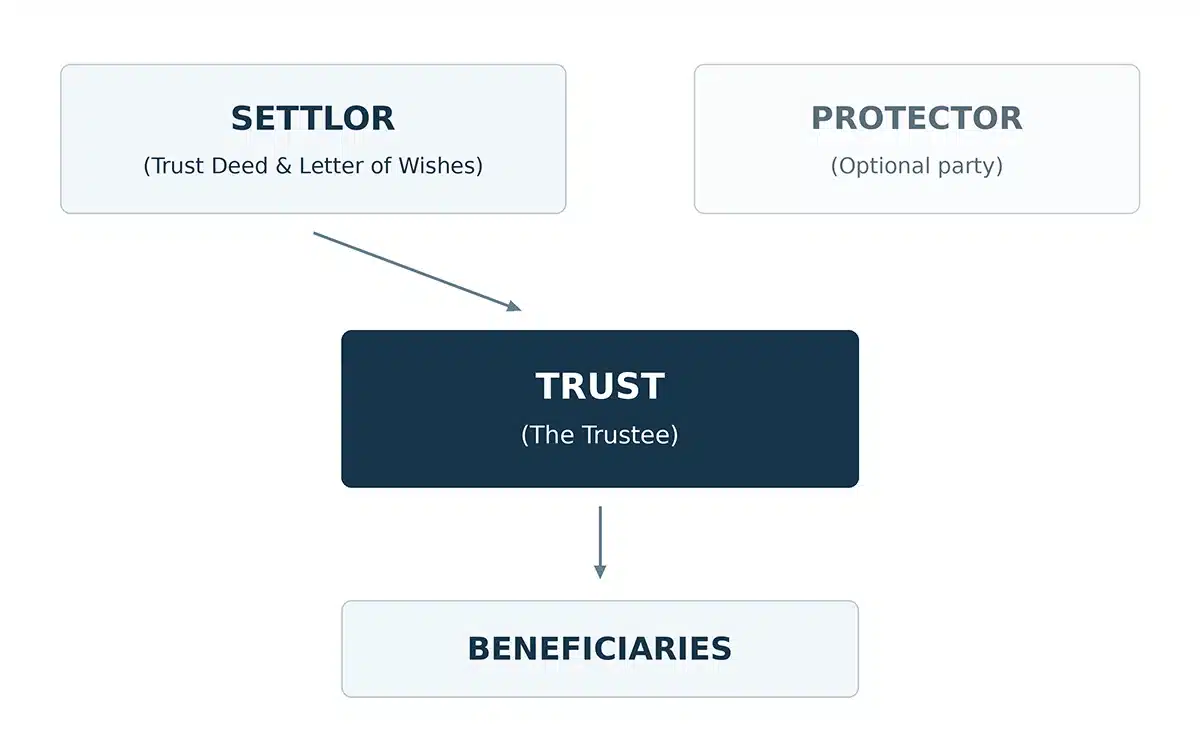
A trust is a legal arrangement whereby certain assets belonging to a Settlor are entrusted to one or several trustee(s) for the benefit of one or several beneficiary(ies). The presence of a protector, appointed to supervise the trustee is optional.
Technically, a trust is not a legal entity: the agreement between the settlor and the trustee consists of a transfer of the legal ownership of assets for the benefit of persons designated in the Trust Deed. The Trustee is therefore vested with legal ownership, while an equitable interest is held by or granted to the beneficiaries.
Section 3 of the Trust Act 2001 states:
‘(1) For the purposes of this Act, a trust exists where a person (known as a “trustee”) holds or has vested in him, or is deemed to hold or have vested in him, property of which he is not the owner in his own right, with a fiduciary obligation to hold, use, deal with or dispose of it –
(a) for the benefit of any person (a “beneficiary”), whether or not yet ascertained or in existence;
(b) for any purpose, including a charitable purpose, which is not for the benefit only of the trustee; or
(c) for such benefit as is mentioned in paragraph (a) and also for any such purpose as is mentioned in paragraph (b).
(2) Notwithstanding sections 893, 896, 931 and 1130 of the Code, property and rights may be transferred to or vested in a trust in accordance with this Act.
The mechanism of the trust can be summarised as follows:
1.2. The Trust Act: a source of legal certainty
Whilst the Trust Act 1989 was the first Mauritian legislation to regulate trusts, the development of offshore financial centres and the growing need for flexible legal structures for wealth management led to the adoption of the above-mentioned Trust Act 2001.
This more precise piece of legislation now sets out the legal framework for the creation, administration and dissolution of Mauritian trusts. It modernised the Mauritian legal framework by introducing new provisions to enhance transparency, the accountability of trustees and, indeed, the protection of beneficiaries.
On the one hand, this legislation sets out new requirements regarding the qualifications of trustees. A trust must, at all times, have at least one qualified trustee (a management company authorised by the Financial Services Commission (FSC) or any other person resident in Mauritius and authorised by the FSC to provide trust administration services).
Article 2 of the Trust Act 2001 indeed states that:
“Qualified trustee means a management company or such other person resident in Mauritius as may be authorised by the Commission to provide trusteeship services […]”
In short, unlike under English law, where any adult of sound mind may in principle be appointed as a trustee without formal authorisation, Mauritian law makes the very existence of the trust contingent upon the permanent involvement of at least one qualified trustee.
These must now be natural or legal persons authorised by the FSC, and are required to uphold the highest standards of integrity and loyalty in the conduct of their business. Specifically, qualified trustees are required to comply with the provisions set out in the Code of Conduct and Ethics, which defines duties relating to corporate trusteeship services:
“A Qualified Trustee should have in place a Code of Conduct and Ethics which sets out the rules of conduct and behaviour for its relevant officers in their discharge of their duties regarding corporate trusteeship services.” [1]
“The TSP (Trust Services Providers) should ensure that its relevant officers are fully conversant with the Code of Conduct and Ethics, which provides for disciplinary actions and sanctions in the event of a breach or non-compliance therewith.”
Since the adoption of the Trust Act 2001, the FSC has had the power to conduct investigations into trusts, issue injunctions to trustees and even bring legal proceedings against them. In this regard, the Black River Trust Company Ltd case (2017 SCJ 420) is a significant example of the FSC exercising its sanctioning powers to preserve the integrity of the wealth management sector.
Black River Trust Ltd, a company offering trust services, was subject to licence suspension proceedings in March 2017. These proceedings followed the arrest of a British national suspected of drug trafficking and money laundering. Investigations revealed serious failings in the company’s internal practices, which are alleged to have served as a conduit for money laundering.
Two years after the suspension, Black River Trust had its licence permanently revoked due to significant breaches of the regulations (notably shortcomings in KYC and a lack of cooperation with the authorities).
Beyond the specific case in question, this matter illustrates the FSC’s determination to send a strong message to stakeholders, reaffirming its commitment to combating money laundering, in accordance with the international standards to which Mauritius adheres[2].
1.3. Secondary sources of Mauritian trust law
Alongside the Trust Act 2001, other legislative and regulatory texts complete the legal framework for trusts in Mauritius:
- Financial Services Act 2007: a key element in the establishment of the FSC, which confers upon the latter the responsibility for regulating financial services in Mauritius;
- The Anti-Money Laundering and Counter-Terrorism Financing Act 2002: imposes obligations on trustees regarding the fight against money laundering and the financing of terrorism;
- The Insolvency Act 2007: governs bankruptcy and insolvency in Mauritius, particularly in relation to trusts;
- The Mauritian Code civil: defines a trust as a separate, autonomous estate distinct from that of the settlor, the trustee and the beneficiary (Article 1100-1).
II – Conditions for validity and diversity of Mauritian trusts
2.1. Conditions governing validity
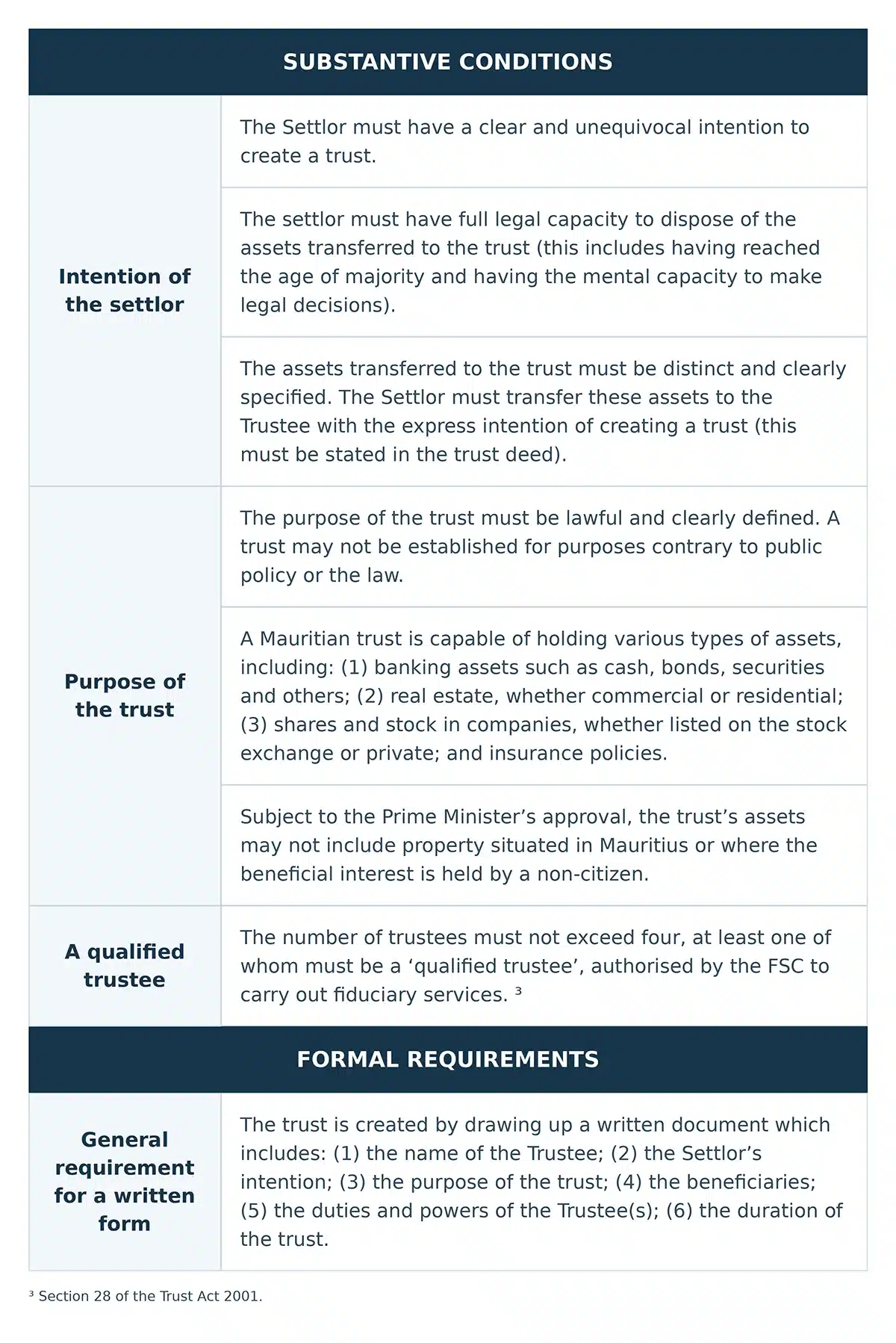
For a trust to be valid in Mauritius, it must satisfy several substantive conditions, as provided for in the Trust Act 2001 and clarified by case law. These conditions are intended to ensure the validity and enforceability of the trust against third parties.
Intention of the settlor
The Settlor must have a clear and unequivocal intention to create a trust.
The settlor must have full legal capacity to dispose of the assets transferred to the trust (this includes having reached the age of majority and having the mental capacity to make legal decisions).
The assets transferred to the trust must be distinct and clearly specified. The Settlor must transfer these assets to the Trustee with the express intention of creating a trust (this must be stated in the trust deed).
Purpose of the trust
The purpose of the trust must be lawful and clearly defined. A trust may not be established for purposes contrary to public policy or the law.
A Mauritian trust is capable of holding various types of assets, including: (1) banking assets such as cash, bonds, securities and others; (2) real estate, whether commercial or residential; (3) shares and stock in companies, whether listed on the stock exchange or private; and insurance policies.
Subject to the Prime Minister’s approval, the trust’s assets may not include property situated in Mauritius or where the beneficial interest is held by a non-citizen.
A qualified trustee
The number of trustees must not exceed four, at least one of whom must be a ‘qualified trustee’, authorised by the FSC to carry out fiduciary services.[3]
Formal requirements
General requirement for a written form
The trust is created by drawing up a written document which includes: (1) the name of the Trustee; (2) the Settlor’s intention; (3) the purpose of the trust; (4) the beneficiaries; (5) the duties and powers of the Trustee(s); (6) the duration of the trust.
2.2. The variety of Mauritian trusts
Mauritius, as a dynamic jurisdiction, offers a range of different trust types, allowing stakeholders to select the kind best suited to their needs.
2.2.1. The spendthrift trust
A trust whose primary purpose is to protect assets against future creditors, litigation, and other exterior risks.
2.2.2. Purpose trust
A type of trust created to achieve a specific objective (such as holding an asset), without individually identified beneficiary. The purpose trust must meet certain validity requirements; in particular, its objective must be specific, reasonable and achievable, and therefore cannot be immoral, illegal or contrary to public policy.
The purpose trust is of particular interest for achieving social or environmental objectives. It thus enables a project or cause to be sustained by ensuring the professional management of the funds dedicated to its realisation, regardless of the presence or identification of individual beneficiaries.
2.2.3. Charitable trusts
A type of trust created for the purpose of achieving objectives in the public interest. A trust is considered charitable when its purpose is to fulfil one of the following objectives[4] : the alleviation of poverty; the promotion of education; the promotion of religion; the protection of the environment; the promotion of human rights and fundamental freedoms; or other objectives beneficial to the general public.
A trust created for one or more of these purposes is deemed to be charitable even if:
- The object or purpose is not of a public nature or for the public benefit, but may benefit a section of the public, or members of the public, or may also benefit privately one or more persons or objects within a category of persons not resident in Mauritius;
- The trust is capable of being amended or terminated, whether by the exercise of a power of appointment or a power to dispose of the assets;
- The trustee has the power to defer the distribution of profits to a charitable organisation or another beneficiary of the trust for a period not exceeding the duration of the trust;
- The trust may be discretionary;
- The charitable objects are pursued in Mauritius or elsewhere and are beneficial to the community in Mauritius or elsewhere.
This type of trust enables philanthropic or public-interest initiatives to be structured and sustained over the long term, whilst benefiting from a favourable legal framework and professional fund management; it offers donors the opportunity to support causes close to their hearts whilst enjoying tax benefits[5].
2.2.4. The discretionary trust
Primary used for asset protection and tax planning, this is probably the most common and flexible form of trust in Mauritius: indeed, the trustees may add or remove beneficiaries and follow the settlor’s instructions contained in a letter of wishes.
Discretionary trusts can be combined by trustees with offshore entities, such Global Business Companies[6]. Discretionary trusts essentially allow the trustee to decide how to distribute the trust’s assets amongst the beneficiaries according to their circumstances and needs.
2.2.5. Employee Benefit Trust
A type of trust commonly used by companies to offer benefits to their employees (in the form of cash or shares) in a tax-efficient manner. The structure of the trust allows the shares and other assets of the trust to be held at the discretion of the trustees. The beneficiaries may include all current and former employees and certain members of their families.
The Employee Benefit Trust may be funded through donations from the founding company, loans granted by the employer, or other forms of financing. A trust deed and detailed rules are drawn up.
III – Tax rules
Mauritius has established itself as a leading financial centre thanks to a particularly attractive tax framework, which is extended to trusts.
3.1. Limited or reduced taxation
Mauritian tax residency is a key criterion. Under the Mauritian Income Tax Act, trusts and foundations fall within the broad definition of a “companies”. Accordingly, a trust is deemed resident if it is administered in Mauritius and a majority of the trustees are resident in Mauritius, or if the settlor was resident at the time the instrument creating the trust was executed[7]. Conversely, a trust whose central management and control is located outside Mauritius will be treated as non-resident[8].
Non-resident trusts are in principle subject to tax only on income of Mauritian source (source-based taxation). Foreign income is therefore not taxable in Mauritius. The trust must nevertheless file an annual tax return with the Mauritius Revenue Authority, even if no tax is actually due.
As regards resident trusts, these are subject to tax on worldwide income at a flate rate of 15%. However, under certain conditions they may claim a partial exemption of 80% on certain categories of income (notably foreign dividends and interest), subject to meeting substance requirements set out in the Income Tax Act.
3.2. No inheritance or gift tax
Mauritius does not levy inheritance tax or gift tax. This is one of the major attractions of Mauritian trusts, as gratuitous transfers of assets made through a trust may be heavily taxed in other countries.
Please note that this overview of the Mauritian tax framework applicable to trusts is deliberately brief and is by no means exhaustive. Tax rules may vary depending on the type of trust chosen or the specific circumstances. We kindly invite readers of this article to contact us for specific and tailored advice should they deem it necessary.
IV – Asset structuring and estate planning through trusts
4.1. A family protection tool
Whilst the Mauritian trust is often used as a wealth management tool, it is also of particular importance in terms of family protection and intergenerational transmission. It not only makes it possible to determine who will inherit the assets, but also to define how they will be preserved, managed, used and passed on over time.
This structure makes it possible, in particular, to pass on assets to minor children without immediately granting them control over them. The Trust Deed can organise the preservation and gradual distribution of assets, enabling the estate to remain a source of support without, too soon, becoming a source of power in the hands of those who are not yet ready to exercise it. This protection can be particularly valuable for minors. Indeed, section 10 of the Act permits, subject to certain conditions, the accumulation of income from the trust, whilst section 46 allows the trustee to use income attributable to a minor beneficiary for their maintenance, education or benefit, whilst preserving the capital for subsequent distribution.
The trust thus makes it possible to tailor the transfer to the specific needs of each beneficiary. Section 14, in particular, permits the appointment of beneficiaries individually or by reference to a class of persons or a relationship with another person, as well as the addition, exclusion or subjection of their interest to certain conditions. This flexibility is, however, subject to the duty of impartiality of the trustee set out in section 40 where several beneficiaries are involved.
The management of the assets is itself subject to strict obligations. Pursuant to sections 37 and 38 of the Act, the trustee must act in good faith, with diligence, prudence and competence; administer the assets in accordance with the trust deed and in the interests of the beneficiaries; preserve and, as far as is reasonable, enhance the value of the assets; and keep appropriate accounts and records. The possible appointment of a Protector, as provided for in section 24, may also strengthen the governance of the trust and help to ensure, over time, that the balance intended by the settlor is maintained.
4.2. Trust transfers must comply with mandatory Mauritian succession rules
Notwithstanding the above, Mauritian trusts cannot be used as means of circumventing mandatory rules of succession. It allows for the organisation of the transfer; it does not allow the rights reserved by law for heirs to be set aside or fraudulently circumvented.
Section 1100-3 of the Mauritian Civil Code provides that, subject to certain conditions, assets placed in trust are not counted towards the disposable portion of the estate and are not subject to “rapport” merely by virtue of being placed in trust. This freedom of organisation is, however, subject to one key limitation: the trust may not infringe upon the rights of heirs where, on the date of death, the settlor is a Mauritian national or domiciled in Mauritius. These protected rights may also be invoked in respect of immovable property situated in Mauritius.
Nota bene. Mauritian law does notrequire compliance with the reserved portion of estates in the absence of any connection with the Island.
Sections 1100-4 and 1100-5 of the Mauritian Code civil supplement this framework by setting out the mechanisms for “reduction” where the transferred assets exceed the disposable portion, as well as the rules for determining their value.
The trust thus appears not as a means of circumventing the rules of succession, but as a tool for estate planning, enabling the settlor’s wishes to be given form and continuity, whilst respecting the most important rules of succession.
4.3. A relevant solution for cross-border estates
This line of thinking takes on particular significance in a world where families – like their estates – are no longer bound by national borders. A family estate may now consist of bank accounts, financial investments, shareholdings, property and other assets spread across several jurisdictions.
As the number of jurisdictions increases, the process of passing on assets can also become more complex. A trust can provide a unified framework for holding and managing assets, making it possible to centralise certain assets and to determine, in advance, how these will be administered and passed on for the benefit of the family. The Trusts Act 2001 also establishes a specific regime applicable to foreign trusts and the determination of their proper law, notably in sections 60 and 61.
This aspect is of particular importance where the settlor, the beneficiaries or the assets have links to several legal systems. The trust can then act as a unifying thread across several jurisdictions, bringing coherence to an estate planning structure which, without it, might otherwise be fragmented across different legal systems.
This flexibility, however, requires rigorous analysis. It is necessary to determine, for each asset, whether it can validly be transferred to the trust and to anticipate the legal, tax and inheritance consequences that may arise from such a transfer, in each relevant jurisdiction.
Thus, in the context of international wealth management, the trust is not a universal solution; rather, it is an instrument of wealth architecture, the effectiveness of which depends on the precision with which the various relevant legal systems have been reconciled.
4.4. Ensuring the continuity of the settlor’s wishes
Finally, trusts may be used to guarantee continuity in the settlor’s wishes beyond their death. Unlike a will, which primarily governs the distribution of assets, a trust can provide a long-term, dynastic, framework for the administration and use of those assets.
Section 27 of the Trusts Act 2001 allows the settlor to provide the trustee with a Letter of Wishes, setting out their intentions and guidance regarding the performance of the trustee’s duties. In principle, this does not have the same binding effect as the Trust Deed, but it nonetheless serves as a useful tool to guide the trustee.
The trust thus appears to be a complementary instrument to wills and gifts, enabling not only the transfer of an estate but also the long-term organisation of its management so that it continues to protect the family and serve the long-term interests of the beneficiaries.
Conclusions
The trust – a reliable and flexible structure derived from Common Law – is a valuable tool for estate planning and asset structuring. Through the Trusts Act 2001, Mauritius has successfully capitalised on this institution by combining it with a favourable and predictable tax environment.
The Mauritian trust is thus well-suited to a wide range of situations (intergenerational transfers, the protection of business assets, the structuring of cross-border estates, the pursuit of charitable objectives, etc.).
In short, the success of the Mauritian model – which stems from its ability to offer a robust, flexible and credible legal framework that complies with international standards – is evident in the field of trusts.
We hope our readers enjoy this article, and the Citizen Consult team stands ready to answer any questions you may have.
[1] Financial Services Commission Mauritius “Practice notes for qualified trustees and management companies when providing corporate trusteeship services and recording beneficial ownership information” – 3.3 Code of Conduct and Ethics – 3.3.1.
[2] Mauritius is currently a signatory of manu international agreements relating to tax information standards and is a signatory to the OECD Declaration on International Investment and Multinational Enterprises
[3] Section 28 of the Trust Act 2001.
[4] Section 19-6 of the Trust Act 2001.
[5] Charitable trusts that apply their income exclusively to their charitable purposes may qualify for income tax exemption in Mauritius under the Income Tax Act 1995, subject to approval by the Mauritius Revenue Authority.
[6] Section 49 of the Trusts Act 2001.
[7] Section 73 of the Income Tax Act.
[8] Section 73A of the Income Tax Act